
by Emma Pickering
Introduction
Technology has enabled incredible advancements for us all, especially in connecting and supporting disabled people. However, while it can empower survivors of domestic abuse, it can also facilitate harm and create barriers to seeking support. This blog explores the unique challenges faced by women with physical disabilities, who are experiencing domestic abuse.
As technology has evolved, so has the need for support. Refuge’s specialist Technology-Facilitated Abuse and Economic Empowerment provides dedicated support for survivors to stay connected online safely.
15 women were interviewed who have disclosed a physical disability, and have accessed Refuge’s tech-facilitated abuse support.
* All names have been changed and key details have been anonymised.
Technology-Facilitated Abuse
“We had cameras in every room, listening devices, smart tech all through the home, that I did not want and did not set up, I had no access to any of the Apps. I often said I felt uncomfortable with the cameras and my ex-partner just dismissed me and said he only put them there for my benefit… He used my disability to abuse me, and everybody saw this as OK because I have less autonomy of my body and surroundings because of my disability, and this is wrong”. – Kate*
Adaptive technology within the home is a lifeline for many disabled women, and many survivors find digital connection empowering post-separation. However, during their relationships, technology is often weaponised, and adaptive technology withheld in order to control and isolate them.
Technology-Facilitated abuse can include:
- Harassment on social media, often with poor response to complaints from platforms
- Abusers using technology to track and survey, often misinterpreted by agencies as support
- Online hate crimes
- Abusers sharing personal information online
- Scams
- Romance fraud
At Refuge, we are seeing that disabled survivors who report concerns are often dismissed by agencies, who believe their abusive partners over them.
“My ex-partner knew that I needed my screen reader and talking aids to help keep me independent. He would often hide them and when I told him I couldn’t find them, he would beret me and tell me I was stupid… many times it left me unable to read emails and work. I became so depressed and isolated from my friends online. He wanted me to become more reliant on him, and for a while it worked”. – Simran*

Economic Abuse
Economic abuse involves someone seeking to access or control your access to money, for example:
- Withholding your access to your bank cards or statements
- Committing fraud in your name, or pressuring you to take a loan which leaves you in debt
- Hiding gambling problems
- Misusing carers allowance, for example by using your disability to convince agencies to give money directly to them
- Misuse of the mobility scheme, such as using provided cars for their own gain, withholding your access and resulting in missed appointments
Every survivor interviewed disclosed an element of economic abuse within their relationship.
“My ex-partner never let me have access to our bank account… It kept me trapped in the home and isolated, over time what little independence I had was lost. All my Social Workers saw was an attentive partner… because I have a physical disability, they just assumed that I didn’t want to go out on my own and was able to have a say over my own finances”. – Kara*
“My ex-husband had a huge gambling problem… I repeatedly asked to see our bank accounts and he wouldn’t let me… When I left the relationship, I was supported to complete a credit check. It was only then that I understood the true scale of the problem, he had remortgaged the house, taken out loans in my name and had a huge overdraft on our joint account. I was left liable for these debts. It wasn’t until I had support from an agency to liaise with the creditors that I understood my rights, before then I was repeatedly dismissed”. – Catherine*

Our research shows that abusers use their partner’s disability to get away with this form of abuse. At the same time, survivors are deemed less capable of making informed decisions for themselves and managing their money.
This makes it easier for their abusers to manipulate the system and agencies into communicating only through the abuser, often causing a lack of trust that becomes a barrier to reporting abuse.
A lack of services for survivors whose first language is not English creates additional barriers to accessing support.
Safe housing
“I called a local domestic abuse service, and they completed a risk assessment they said I was high risk. I said I feared my partner and wanted to leave the relationship, when I disclosed that I was visually impaired they explained that finding a refuge space to accommodate me would be difficult. They tried, and I couldn’t leave.” – Sana*
Access to safe accommodation is key to seeking safety. However, for disabled survivors there is a lack of accessible services. Many never try to access a refuge, assuming it won’t be accessible for their needs, leaving them feeling trapped.
“I tried to move into a refuge, both me and my child have disabilities…When I told the person on the phone that my child needs wheelchair accessible property, I was told they didn’t have any. I am not leaving my child with the abuser; I had no choice but to stay and get him removed from the property, which took months, and we had to all be exposed to his behaviour in the meantime”. – Meera*
Impacts on Children

“My disability was constantly brought up in meetings with Children’s Services, when I wanted to leave the relationship agencies automatically told me that the children would have to stay with their father because I had too many health concerns. I was able to look after the children and the children wanted to stay in my care, but it was never an option. I had no say and neither did the children. Agencies really believed my ex-partner when he told them I wouldn’t be able to wash the children, get them ready for school and feed them. They never knew that he never let me do those things out of control, it was never a question of being able. I think my disability was used as an excuse for the domestic abuse”. – Simran*
Where a woman is reliant on her partner-carer to support with childcare, we often see fear of engaging with agencies due to the threat of children being removed from the family home.
The importance of Specialist Services

Interviews with both agencies and survivors show that there is a clear preference to seeking support from specialist agencies.
While more mainstream agencies are improving their accessibility features, for example by offering British Sign Language services, translation services and ensuring their content aligns with screen readers, there is still more to do.
Survivors appreciate support from people that have lived experiences and are representative of their own needs, for instance SignHealth, a charity working with the Deaf community.
There are many reasons why a disabled woman might not engage with services, and adjustments must be made to ensure places and services are accessible to all.
For survivors who live in more remote areas, local support groups will not run as regularly as groups in cities, if at all. They also may take place further away, requiring transport.
By asking questions relating to the needs of disabled survivors, specialist services ensure adjustments are in place, resulting in more disabled survivors staying engaged with the support plan.
Improved risk assessments could help identity missed opportunities to engage with survivors. Agencies must ask the right questions and adjust to survivors’ needs before approaching the standardised risk assessment.
Intersectionality
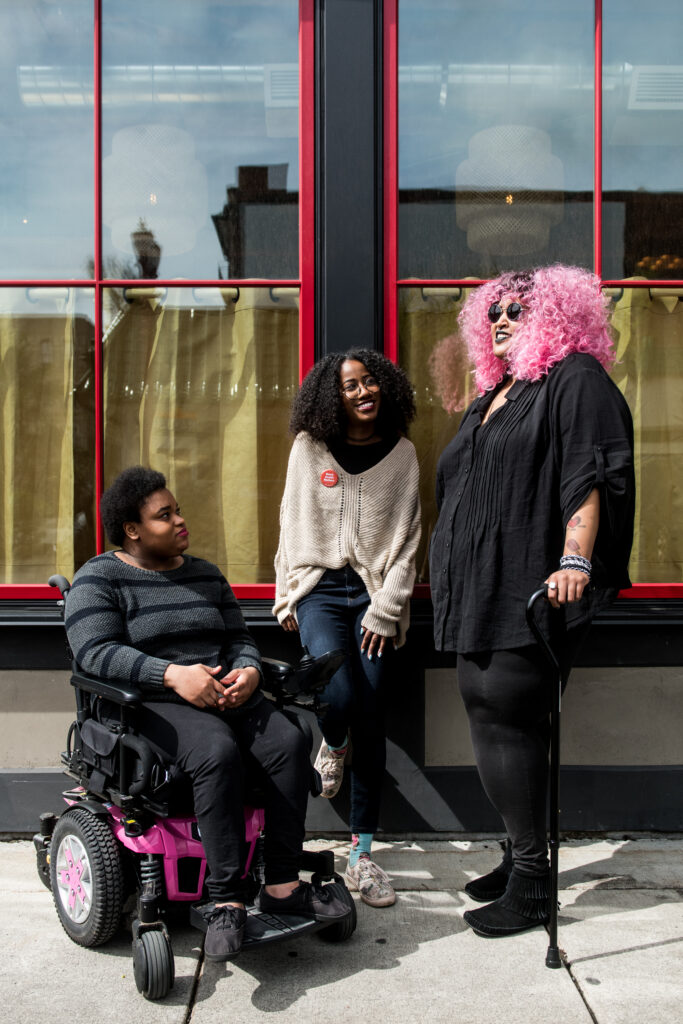
Intersectionality connects different identities under one lens, but intersecting identities tend to be diminished in their relevance of importance. These identities are essential to the lives of the disabled persons.
Both gender and disability can play a role in determining the risk of violence, as girls and young women with disabilities experience up to ten times more violence than those without disabilities.
What needs to change
Disabled women are less likely than non-disabled women to access support when they need it, and research shows disabled women may experience domestic abuse for much longer than non-disabled women.
The experiences of disabled women are marginalised, with some agencies using impairments to excuse inaction instead of focusing on disabled women’s equal rights to safety and justice.
Right now, the systems and structures in place are not preventing abusers from misusing them, and are disproportionately impacting women with disabilities.
We need consistent and available data, and it is essential that disabled women feel empowered to participate in research, and are part of decision-making processes that impacts them.
Policy and Legislation
Discrimination on the basis of disability is illegal. However, there are still gaps, and current legislation is failing to protect and safeguard disabled people.
We are calling for amendments to the Domestic Abuse Act 2021 that address the unique vulnerabilities of disabled women. It must recognise abuse linked to disability as a specific form of domestic abuse. The Government should also commit to improving access to justice through reasonable adjustments, translation services, and assistive tech in court proceedings.
Conclusion
Our interviews with agencies and survivors resulted in several recommendations:
- Centre survivors’ voices: Build trust by engaging directly with disabled women, not just caregivers, during assessments.
- Use professional curiosity: medical practitioners should investigate missed appointments and medication, ensuring there are confidential spaces for disabled women to make disclosures.
- Improve responses for survivors who report hate crimes that are a result of proxy stalking and harassment. Train Police and Trust and Safety teams to respond appropriately. Training should be designed and delivered by disability-specialist agencies.
- Improve public responses to scams and romance fraud. Ensure that support and advice is accessible for women with disabilities.
- As AI advances, ensure that AI bias does not further discriminate against people with disabilities. Ensure that programming has been validated by neurodiverse and disabled users.
- Improve financial policies. While banks have improved systems for vulnerable customers, strengthen this with more attention to protect disabled women experiencing domestic abuse.
- Fund specialist services to ensure disabled women can access dedicated support from agencies that understand and can respond to their needs.
- Design risk assessments for disabled women to first address their accessibility requirements before addressing their risks, to avoid missing key information.
References
Foster, K, Sandell, M, 2010. ‘Abuse of Women with Disabilities: Toward an Empowered Perspective’. Sexuality and Disability, 28 (3). Available at: https://link-springer-com.apollo.worc.ac.uk/content/pdf/10.1007/s11195-010-9156-6.pdf
Harne, L, Radford, J, 2008. Tackling domestic violence: theories, policies and practices. Maidenhead. McGraw-Hill University Press
Thiara, R.K, 2012. Domestic Women and Domestic Violence: responding to the experiences of the survivors. London: Jessica Kinsley
World Health Organisation and the World Bank Group (2011) World Report on Disability. Available at: World Report on Disability (who.int)
Header Photo Credit: Chona Kasinger, for ‘Disabled and Here’
